
Seeing a cluster of bees on your property can stop you in your tracks. Most people immediately think it must be a swarm, but the truth is not every bee cluster is actually a swarm. Some are, and some aren’t. Knowing the difference can alleviate stress or concern and help make the best decision to address it.
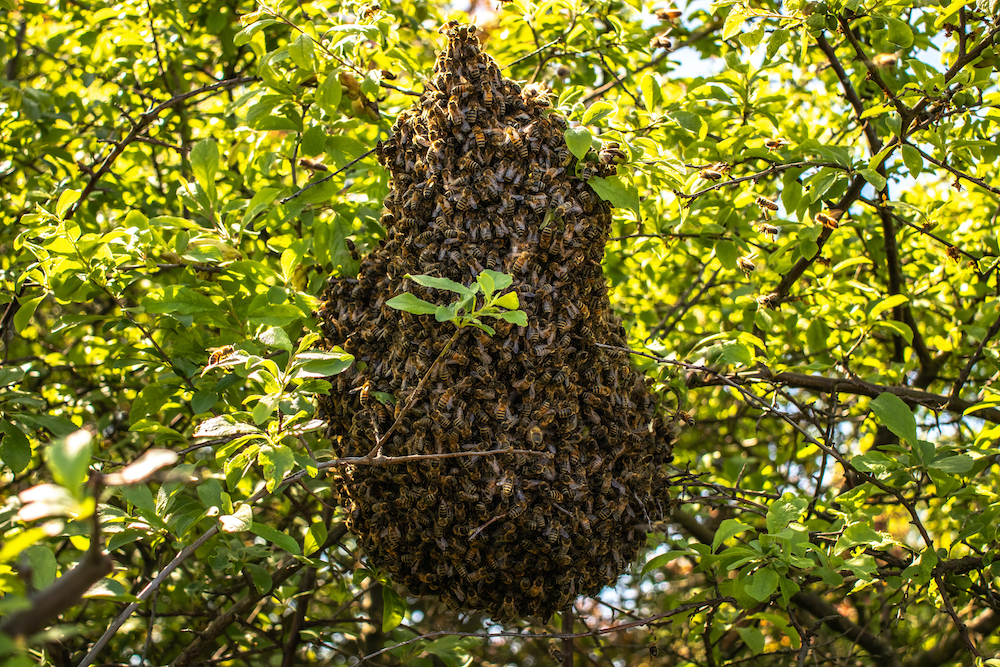
A true swarm happens when a honey bee colony becomes too crowded and needs to reproduce itself. Every colony will need to have a new queen at some point, which is when the old queen leaves with a large group of worker bees to go find a new place to live. While they’re searching for that new home, the bees gather together in a tight cluster somewhere temporary. This could be on a tree branch, fence, mailbox, or even the side of a house. They stay there while scout bees fly around looking for a permanent location. So yes, many bee clusters you see hanging out in the open are swarms, but not always.
What to Do When You See a Ball of Bees
Many people who encounter a swarm say it looks like a ball of bees. These swarms can be on a fence, hanging from a tree, or attached to some other object. It may look like a dark mass, typically about the size of an inflated football. These clusters usually show up suddenly, often within a few hours, and may stay in place for a short time while the bees figure out their next move. In many cases, they are gone within a day or two after finding a new home.
Although clusters and swarms may seem similar, not every group of bees away from their hive is a swarm. Sometimes, what people see is actually bees going in and out of a structure, which usually means there is an established hive nearby. Instead of hanging in one tight ball, you might notice steady activity with bees flying into a crack in a wall, roofline, or shed. That is no longer considered a swarm. That means the bees have already moved in and started building comb inside, which is a very different situation.
Are Bee Clusters Dangerous?
Often, the first thing people wonder when they encounter a cluster of bees is whether it is dangerous. In most cases, true swarms are less aggressive than established hives because the bees don’t have anything to defend yet. They are usually full of honey and focused on finding a new home. Still, that doesn’t mean you should get close to them or try to disturb them. Keeping your distance is always the safest approach, especially if children or pets are around who might get curious and wander too close.
If you see a cluster and aren’t sure whether it’s a swarm or something more permanent, the best thing to do is watch from a safe distance and look for clues. A swarm usually looks like a stationary cluster hanging in one place, with little activity other than a few bees flying in and out. An established hive usually has constant traffic, with bees coming and going from a single hole or opening. That steady movement is often the sign that they’ve already made themselves at home.
Approaching Concerns Over Clusters and Swarms
The approach to clusters and swarms is different in the steps that can be taken. Experienced beekeepers and live bee removal companies have the knowledge and experience working with bees and can help others if they find the bees are in a location that poses risks. Because swarms are temporary, local beekeepers are willing to collect them, sometimes at no cost. There are services like Swarmed that let you report bee clusters and connect with nearby beekeepers who can safely relocate the bees. Beekeepers rely on swarm calls to grow their colonies, which is why they are often first on the scene if a truck transporting bees overturns or another bee catastrophe occurs. Rescuing a swarm is an easy win for beekeepers and the bees that get a new home.
When Bees Move Inside
If the bees have already built a hive inside a structure, though, removal becomes more involved. Established hives usually require specialized tools and experience to remove safely, and there is often a fee for that type of work. That’s another reason it helps to recognize the signs early. Catching a swarm before it settles somewhere permanent can prevent bigger problems later.

Get help with your beehive or bee swarm removal! Call Today 760-224-3040 Or 951-265-8292!
Not All Bee Clusters Are Swarms
The big takeaway is that not every bee cluster is a swarm, but many of them are. Taking a few moments to observe what you’re seeing can help you figure out what kind of situation you’re dealing with. Instead of reacting out of fear, understanding the difference allows you to make a better choice for your safety, your property, and the bees themselves.
Honeybees are among the essential pollinators that play a vital role in pollinating plants and food crops. Every effort to protect them really does make a difference. Anyone who encounters a cluster or swarm can be comforted knowing it isn’t a long-term location in either case. A swarm will naturally move on within a few hours or days, and a cluster is also temporary as bees settle into their new hive location. So, as long as this new location is not inside your wall or attic, there is nothing to be concerned about. Either way, staying calm, keeping your distance, and reaching out to someone experienced, like the bee technicians at D-Tek, is the smartest path forward.